


Great Wildebeest Migration June 2026: Where Are the Herds in the Serengeti?
- cheetahsafaris3
- May 27
- 5 min read
June arrives quietly in the Serengeti. The long rains are retreating, the air is cooling, and somewhere across the vast golden plains, the ground is beginning to tremble. More than 1.5 million wildebeest, joined by hundreds of thousands of zebras and Thomson's gazelles, are on the move, and June is the month everything starts to shift.

If you are planning a safari around the Great Wildebeest Migration in June 2026, you are arriving at one of the most underrated windows of the entire year. It is not the peak of the famous Mara River crossings that comes later, but what June offers is something altogether different: raw, unfiltered movement across an enormous landscape, with far fewer vehicles, more intimate game drives, and the electric anticipation of a spectacle that is still building.
Here is exactly where the herds are, what you can expect to see, and why June 2026 might be the smartest month you could choose.
The State of the Migration in June
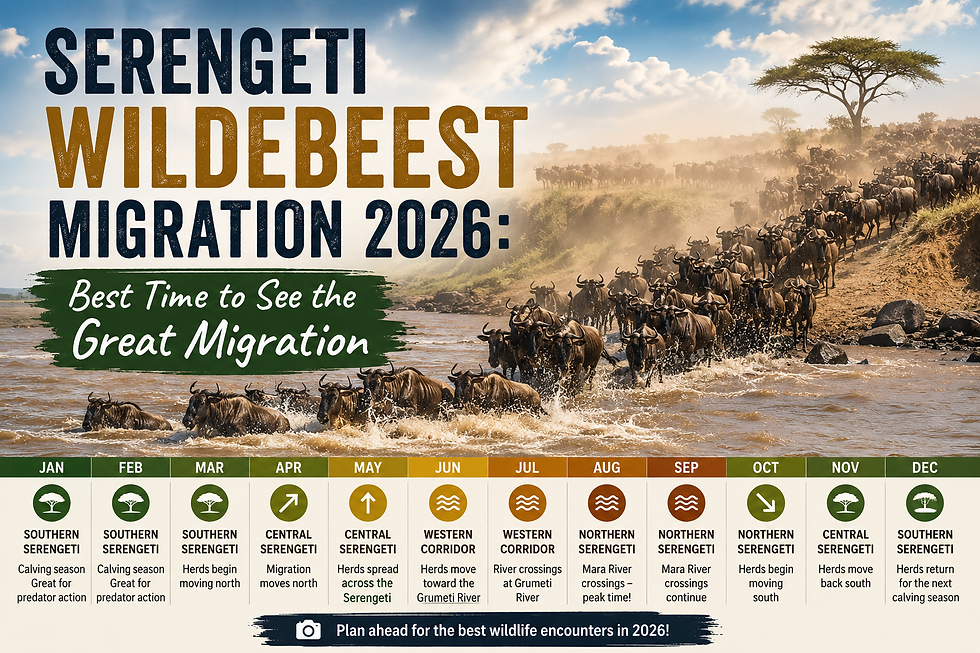
To understand where the herds are in June, you need to understand where they have been. Between January and March, more than 500,000 calves were born on the short-grass plains of the southern Serengeti and the Ndutu Conservation Area. By April, those calves were strong enough to travel, and the great column began its slow drift northward and westward through the central Serengeti.
By the time June arrives, the herds are deep in transition. The southern plains have dried out. The grass that sustained the calving season is gone, and instinct is pulling the animals toward fresher ground in the west and north. This is the month the migration truly becomes a migration purposeful, urgent, and impossible to ignore.
In June 2026, the bulk of the herds will be moving through the Western Corridor of the Serengeti, a stretch of wilderness that runs between the Grumeti River and the central plains. This is mating season, known locally as the rut, and the atmosphere across the plains is extraordinary. Male wildebeest are sparring, bellowing, and chasing one another in dramatic head-to-head clashes. The herds are restless and loud in a way that the calving season never is.
The Grumeti River: June's Main Event
The most dramatic wildlife encounter available to visitors in June 2026 will be found at the Grumeti River. This winding, heavily forested waterway cuts through the Western Corridor, and it presents the first major river obstacle the herds face on their northward journey.
Unlike the Mara River crossings that dominate wildlife documentaries, the Grumeti crossings are less predictable and far less crowded. The river is shallower in most places, but it holds its own dangers, specifically, some of the largest Nile crocodiles on the continent. These crocodiles are enormous, having spent months in near-starvation waiting for this exact moment. When the wildebeest arrive at the banks, the resulting confrontations are among the most dramatic wildlife encounters the Serengeti has to offer.
What makes June special here is that not all of the herds cross at once. Some groups linger for days along the riverbank. Others turn back. The crossings occur on their own schedule, governed entirely by the animals' collective anxiety and the herd's mysterious internal logic. Spending two or three days in the Western Corridor in June gives you a genuine chance of witnessing one.
Where Exactly to Position Yourself in June 2026
The Western Corridor is large, and positioning matters enormously during this month. The areas around Grumeti and Kirawira offer the best access to crossing points and the densest concentration of herds in early to mid-June. Further east, the Seronera Valley remains excellent, it is the wildlife heartland of the Serengeti, with the highest year-round concentration of predators anywhere in the park.
By late June, the leading edge of the migration begins pushing further north toward Lobo and the Northern Serengeti. The herds rarely arrive in full force before July, but late June often brings the first scouts, smaller groups of wildebeest testing the route northward. This is a particularly exciting time if you are positioned in the central or northern Serengeti, because you can watch the landscape change as the animals begin filling it.
The Moru Kopjes area, a striking series of granite outcrops in the central Serengeti, is also worth noting in June. Wildebeest columns frequently move through this area during the month, and the kopjes themselves are home to resident lions who prey heavily on the passing herds. Game drives here in June can produce memorable predator-prey encounters with very little competition from other safari vehicles.
What the Weather Means for Your Safari in June
June marks the beginning of the dry season across the Serengeti, and this works strongly in the safari visitor's favor. The long rains of April and May have cleared. Tracks are passable, grass is beginning to shorten, and the sky produces those clean, sharp East African mornings that make every photograph look effortless.
Temperatures in June average between 15°C at night and 27°C during the day, cool enough for comfort on long game drives, warm enough to feel properly in the bush. The absence of mud means that your vehicle can access areas that are completely off-limits during the wet season, including some of the most productive game-viewing zones along the Grumeti River.
Animal visibility also improves significantly as the vegetation thins. In the wet months, tall grass can conceal an entire pride of lions at fifty meters. In June, the landscape opens up, and sightings become more consistent. This matters especially when you are tracking the migration, because you need clear sightlines to read the movements of the herds across long distances.
Beyond the Wildebeest: What Else June Offers
The migration dominates every conversation about the Serengeti in June, but it is worth knowing that the rest of the ecosystem is equally alive during this month. The arrival of hundreds of thousands of wildebeest is a banquet for predators, and June sees elevated activity from lions, cheetahs, leopards, hyenas, and wild dogs.
Cheetah sightings in the central Serengeti are particularly good in June. The open, drying grassland suits their hunting style perfectly, and with wildebeest calves now a few months old but still relatively inexperienced available as prey, cheetahs are active and visible throughout the day. It is not unusual to witness multiple hunts on a single morning game drive during this month.
Bird life is also exceptional in June. The Serengeti holds over 500 recorded bird species, and the transition between the wet and dry seasons brings an impressive mix of resident and migratory species. Raptors in particular are highly visible in June, drawn by the movement of prey animals across the open plains.
Planning Practically for June 2026
June sits at the opening of peak season, which means availability at the best camps in the Western Corridor and Northern Serengeti fills up quickly. If you are targeting June 2026 specifically, camps along the Grumeti River should already be on your booking list. Mobile tented camps, which follow the herds, are especially valuable this month because they reposition to track the migration as it moves.
A minimum of five nights in the Serengeti is recommended for a June migration safari, ideally split between the Western Corridor and the central Seronera area. This gives you coverage across the two main zones where the herds are concentrated during the month, and it accounts for the unpredictability that is fundamental to any wildlife experience.
June 2026 in the Serengeti is not a compromise between seasons. It is a destination in its own right, the moment the migration shifts from a story of birth into something faster, louder, and altogether more urgent. The herds are moving, the predators are watching, and the Grumeti is waiting. There has never been a better reason to be there.

Comments