


Wildebeest Migration Safaris 2026: Complete Guide
- cheetahsafaris3
- May 20
- 5 min read

Every year, more than 1.5 million wildebeest move across the Serengeti-Mara ecosystem in a loop that has no fixed start and no defined finish. They follow the rain. They follow the grass. And in doing so, they create one of the most dramatic wildlife spectacles the natural world offers.
If you are planning a migration safari in 2026, the single most important thing to know is this: the migration does not perform on demand. It moves according to rainfall patterns, grass availability, and instinct built over millions of years. Your job, and that of a good safari operator, is to position you in the right place at the right time. This guide walks you through exactly how to do that.
How the Migration Actually Works
The wildebeest migration is a circular journey covering roughly 1,800 miles across Tanzania and Kenya. The herds, which also include around 200,000 zebras and 500,000 Thomson's gazelles, graze their way through the Serengeti before pushing north into the Masai Mara, then looping back south again.
There is no single "migration event." It is a continuous movement with several peak moments that safari travelers specifically target.
The Annual Cycle at a Glance
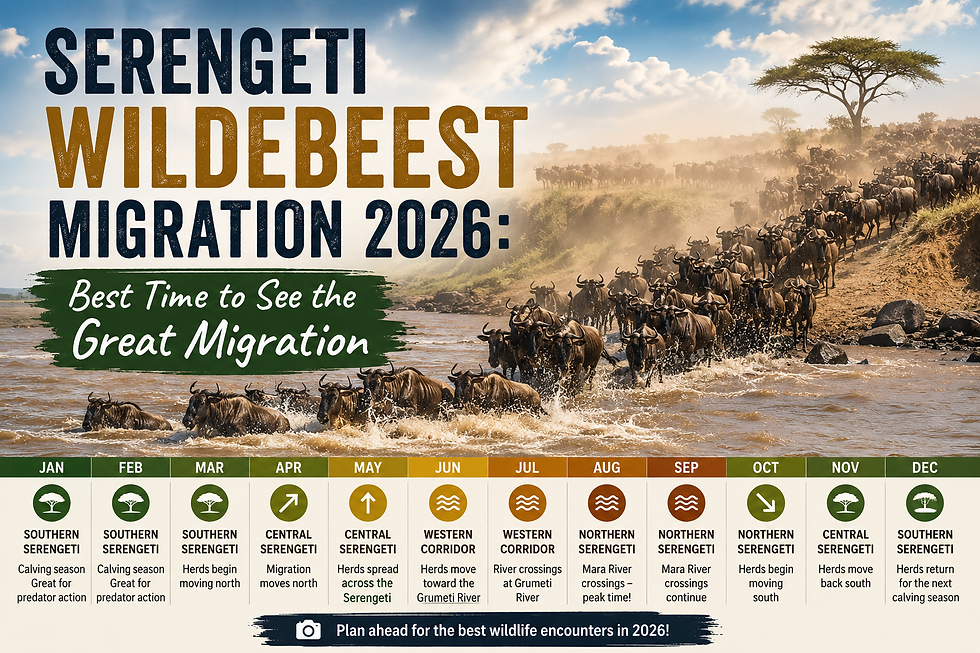
January – March: Calving Season in the Southern Serengeti The herds gather on the short-grass plains of Ndutu, in the southern Serengeti and Ngorongoro Conservation Area. This is calving season approximately 500,000 calves are born within a few weeks. Predator activity intensifies dramatically. Lions, cheetahs, and hyenas are highly active, making this one of the best periods for big cat sightings.
April – May: The Herds Move North As the southern plains dry out, the herds begin pushing northwest toward the central and western Serengeti. Rain makes road conditions difficult in some areas, but the landscape turns lush and green, and the sheer volume of animals on the move is extraordinary.
June – July: The Western Corridor and Grumeti River The herds reach the Grumeti River in western Serengeti. Crocodile crossings here are less publicized than the Mara crossings but equally intense. The Grumeti's resident crocodiles are among the largest in Africa, and they wait.
July – October: The Mara River Crossings This is what most travelers picture when they think of the migration. The herds push into Kenya's Masai Mara and must cross the Mara River — multiple times, in both directions to access fresh grazing. The crossings are unpredictable. Some days nothing happens. On others, thousands of animals plunge into croc-filled waters within minutes of each other. Peak crossing activity typically runs from late July through September.
November – December: The Return South The short rains arrive in Tanzania, the grass greens up, and the herds begin moving south again through the eastern Serengeti toward Ndutu, completing the loop.
Where to Be and When in 2026
Choosing your destination depends entirely on which aspect of the migration matters most to you.
Best for River Crossings: Masai Mara, Kenya (July–October 2026)
Position yourself along the Mara River between late July and late September for the highest probability of witnessing a crossing. The northern Serengeti just across the Tanzanian border offers an equally strong viewing experience with fewer crowds than the Kenyan side.
Camp within the ecosystem rather than outside it. Mobile camps that shift location to follow the herds offer a significant advantage over fixed lodges that cannot reposition.
Best for Big Cat Action: Southern Serengeti (January–March 2026)
The Ndutu area in early 2026 will draw travelers who prioritize predator sightings over crossings. With hundreds of thousands of vulnerable newborn calves on the plains, lions and cheetahs operate in open daylight. This is also one of the most photogenic periods — soft light, open landscapes, and dramatic action.
Best for Value and Fewer Crowds: Western Corridor (June–July 2026)
The Grumeti River area remains underrated. The crossings here happen earlier in the season and attract a smaller volume of tourists. If you want the experience without the convoy of safari vehicles, the western corridor in June and July 2026 is worth serious consideration.
Choosing the Right Safari for the Migration
The migration demands proper planning, not just a flight to Nairobi and a hope for the best.
Mobile Camps vs. Fixed Lodges
Fixed lodges offer comfort and consistency, but they cannot follow the herds. Mobile camps canvas tented camps that relocate seasonally track the migration and position guests directly in the action zone. For serious migration travelers, a mobile camp is the better strategic choice.
Tanzania vs. Kenya
Both countries offer outstanding migration experiences, and the best itineraries include time in both. Tanzania covers the majority of the migration route and offers the full annual cycle. Kenya's Masai Mara is essential for the river crossings. A combined 10–14 day itinerary that starts in northern Tanzania and finishes in the Mara is the most comprehensive approach.
How Many Days Do You Need?
A minimum of seven days gives you a real chance at the migration. Ten to fourteen days is ideal. The unpredictability of crossings means that a three-day trip to the Mara is a gamble you may see nothing, or you may see three crossings in a single afternoon.
Cheetah Safaris designs itineraries specifically around migration timing and positioning, adjusting departure dates and camp locations based on updated field intelligence rather than fixed seasonal calendars.
What to Pack for a Migration Safari
Travel light, but pack smart.
Clothing: Neutral colors khaki, olive, tan. No white, no bright tones. Layers are essential; mornings on the Mara are cold.
Optics: Bring your own binoculars. 8x42 is the standard recommendation.
Camera: A telephoto lens of at least 300mm makes a significant difference. River crossings happen fast and at a distance.
Health: Yellow fever vaccination is required for Kenya if arriving from certain countries. Antimalarial prophylaxis is strongly recommended. Confirm requirements with your operator well in advance.
Footwear: Closed-toe shoes for game drives. Sandals for camp.
Practical Booking Advice for 2026
The best mobile camps for the July–October crossing season sell out between 12 and 18 months in advance. If you are reading this in early 2026, availability for peak season is already limited.
Book your preferred dates now and confirm the camp's positioning strategy before you commit. Ask your operator specifically where their camp will be located in your travel window and how they adjust if the herds shift.
Cheetah Safaris works with a network of camps across both Tanzania and Kenya and provides clients with pre-departure field updates so you arrive knowing exactly what to expect on the ground.
Ready to Plan Your 2026 Migration Safari?
The 2026 migration season is filling fast. Whether you want to witness the Mara River crossings in August, catch the calving season in February, or build a multi-week Tanzania-Kenya circuit, the planning starts now.
Contact Cheetah Safaris today to check availability, get a tailored itinerary, and secure your place in the field before peak-season camps close.
Reach out through the inquiry form or speak directly with a safari specialist who has been on the ground in the Serengeti and Mara, not just behind a desk.

Comments