


Serengeti Wildebeest Migration 2026: Best Time to See the Great Migration
- cheetahsafaris3
- Jul 8
- 5 min read
Ask ten safari guides when the best time to see the wildebeest migration is, and you will likely get ten different answers and all ten will be right. That's because the Great Migration isn't a single event with a start and finish line. It's a continuous, 365-day loop, and the best month depends entirely on which chapter of the story you actually want a front-row seat for.
This guide breaks down what's really happening month by month, which two windows genuinely stand out from the rest, and the planning mistakes that trip up even experienced safari travelers.
First, Let Go of the Idea That There's One "Peak Month"
Most people arrive at this topic assuming the migration is a two-week event they need to time perfectly, like catching a solar eclipse. It is not. Roughly two million wildebeest, along with hundreds of thousands of zebra and gazelle, are somewhere in the Serengeti-Mara ecosystem every single day of the year. They are just not always doing something dramatic.
The animals move because of rain, not because of a calendar. Grass grows where rain falls, and the herds chase it in a rough clockwise circuit that's taken shape over tens of thousands of years. That means the right time to visit is not really about hitting a peak; it's about matching your trip to the specific behavior you want to witness. For a full breakdown of routes, camps, and seasonal positioning, this Wildebeest Migration in Serengeti guide is worth bookmarking as you plan.
The Two Windows Almost Everyone Should Know About
If you only remember two things from this article, make them these.
1. Calving Season — Late January to February
Down in the short-grass plains around Ndutu and the southern Serengeti, something extraordinary happens almost silently every January: within a matter of weeks, several hundred thousand wildebeest calves are born, most of them able to stand and run within minutes of birth. That timing isn't an accident it floods the local predator population with far more prey than they can hunt, which is nature's blunt but effective way of giving the herd, as a whole, better survival odds.
For visitors, this translates into some of the most concentrated predator action anywhere in Africa. Lions, cheetahs, and hyenas all know exactly what's happening, and they don't wait politely.
2. The Mara River Crossings — July Through September
This is the image most people have in their heads when they picture "the migration": thousands of animals bunched at a riverbank, hesitating, and then surging across churning, crocodile-filled water in one chaotic rush. It happens in the northern Serengeti and spills across into Kenya's Masai Mara, and it's genuinely one of the most intense wildlife spectacles left on the planet.
The catch and it's an important one, is that no crossing is ever guaranteed on a specific day. Herds can sit at a riverbank for 48 hours and never commit, then cross somewhere else entirely the next morning.
A Real Planning Example: Two Travelers, Same Week, Different Trips
Here's a comparison that illustrates why "best time" really means "best time for what you want."
Two couples both traveled to the Serengeti in the same September week last year. Couple A booked three nights at a fixed lodge in central Serengeti, about a two-hour drive from the nearest active crossing point. Couple B booked a mobile tented camp that repositions with the herds, staying in the Kogatende area specifically because that's where the migration was concentrated that week.
Couple A saw wildebeest, plenty of them, but no crossing the herds simply weren't near their lodge that week. Couple B watched two separate crossings in four days, including one with an estimated 1,500 animals in a single surge. Same season, same migration, completely different outcomes. The difference wasn't luck it was proximity and flexibility.
The takeaway: during crossing season, where you stay matters as much as when you go. A camp that moves with the herds, or one already positioned in the northern Serengeti, will consistently outperform a fixed lodge further south.
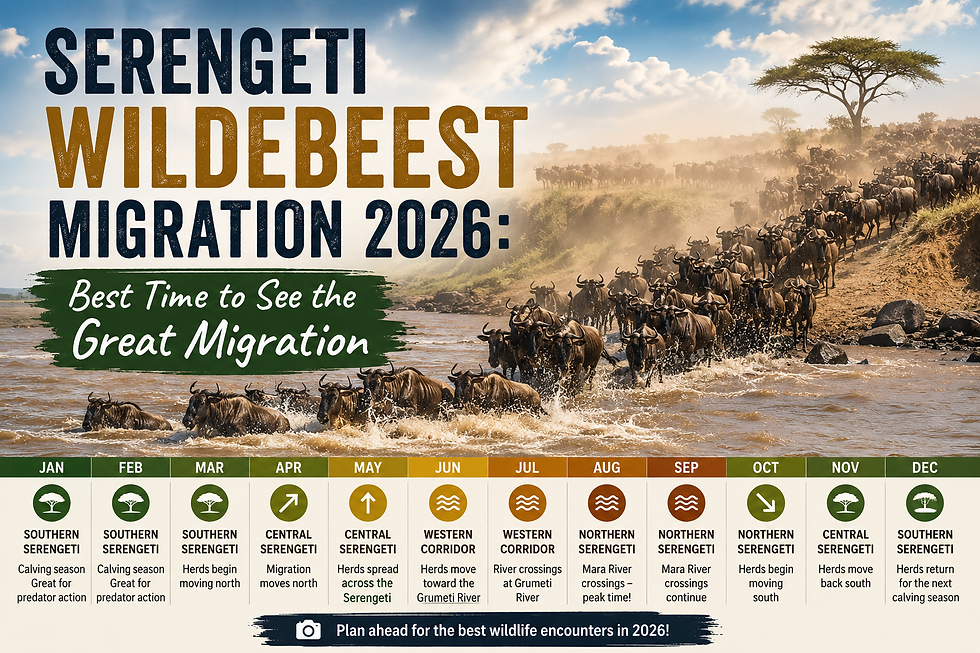
Month-by-Month Snapshot
See what each month offers from weather and wildlife sightings to the best safari experiences across Africa.
Period | Herd Location | What You'll See |
Dec–Mar | Southern Serengeti, Ndutu | Calving, dense predator activity, short-grass plains |
Mar–May | Central Serengeti moving west | Herds thinning out, dispersed, green landscapes |
May–Jun | Western corridor, Grumeti River | First river crossings, fewer crowds |
Jul–Oct | Northern Serengeti, Mara River | Peak crossings, biggest crowds, most dramatic action |
Nov | Eastern Serengeti | Herds are drifting south again, quieter viewing |
Three Practical Tips Most First-Timers Miss
Avoid common safari mistakes with simple tips that make your first African adventure safer, smoother, and more enjoyable.
Book crossing-season camps 9–12 months ahead. The handful of properties genuinely close to the main crossing points (around Kogatende and the Lamai Wedge) sell out for July–September nearly a year in advance. If you're planning a 2026 trip and haven't booked yet, prioritize this over almost anything else on your checklist.
Build in Slack days. A single-night stopover near the river gives you one shot at a crossing. Three or more nights give the herds time to actually show up on your schedule instead of theirs.
Consider the shoulder months on purpose. Late May and early June sit in a genuine sweet spot: rains are easing, the Grumeti crossings are underway, and rates haven't yet hit peak-season pricing. It's one of the most underrated windows on the calendar for travelers who don't need the crowds of August.
Tanzania or Kenya — Does It Matter Which Side You're On?
The Serengeti holds the migration for roughly nine months of its annual cycle the calving grounds, the Grumeti crossings, and the build-up to the Mara crossings all happen almost entirely on Tanzanian soil. Kenya's Masai Mara comes into its own specifically in August and September, when the herds push furthest north, and it offers strong infrastructure and well-established camps for that narrower window. If you only have one trip in you, Tanzania gives you the fuller arc of the story; if your dates are locked into late August, the Mara is a very reasonable alternative.
Final Thought
The wildebeest migration rewards travelers who plan around behavior, not dates on a calendar. Decide whether you want the raw drama of a river crossing or the quieter intensity of calving season, then build your trip and your camp location around that choice. Get that part right, and almost any month can be your best month to witness the Great Migration.
Frequently Asked Questions
What is the single best month to see the wildebeest migration?
There isn't one single "best" month it depends on what you want to see. August is the most dramatic for river crossings, while February offers the most concentrated predator-prey action during calving season.
Can you see the migration in Tanzania all year round?
Yes. The herds never fully leave the Serengeti ecosystem. What changes throughout the year is their exact location and what behavior is on display calving, dispersal, or crossings.
How far ahead should I book a migration safari?
For July–September crossing season, 9–12 months ahead is realistic given how limited northern Serengeti camps are. For calving season in January–February, 4–6 months is usually enough.
Is it better to see the migration in Kenya or Tanzania?
Tanzania covers the larger share of the migration's annual cycle, including calving and the early crossing build-up. Kenya's Masai Mara is strongest specifically in August and September, when the herds are furthest north.
Start Planning Your Wildebeest Migration Safari Today
Planning your own Serengeti trip? Start with a proper wildebeest migration guide from Cheetah Safaris so you can match your travel dates to the right region of the ecosystem before you book anything. Once you have settled on your dates, browse African safaris and tours to find an itinerary built around that window.
Comments