


Kenya and Tanzania Safari Cost 2026: Budget, Mid-Range & Luxury Breakdown
- cheetahsafaris3
- Jun 16
- 10 min read
Introduction
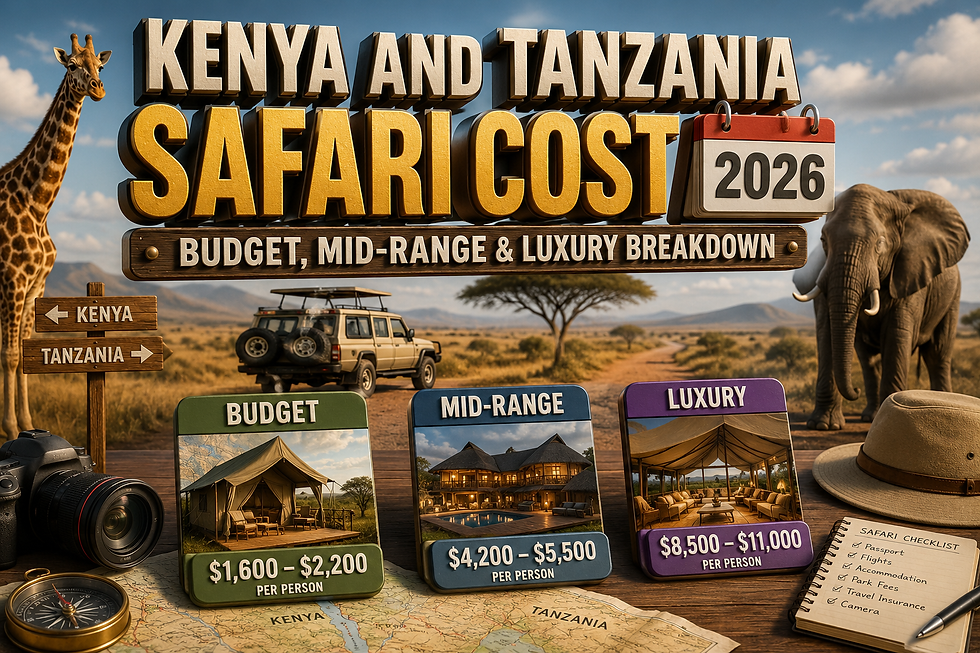
Planning a Kenya and Tanzania Safari requires honest budget conversations. The cost varies dramatically depending on your accommodation choices, travel timing, group size, and the parks you visit. Most travelers land somewhere between $1,400 and $12,000 per person for a combined 10–14 day adventure, but knowing where your money actually goes transforms a vague anxiety into a confident decision.
This article breaks down what Kenya and Tanzania Safaris cost in 2026 across three distinct tiers. We'll show you exactly what each price point delivers, which hidden costs operators sometimes exclude, and how to maximize value without sacrificing wildlife encounters or comfort. Whether you're researching your first safari or comparing operators, this breakdown gives you the tactical knowledge to book with clarity.
Budget Safari Packages: $1,400–$2,100 Per Person (7–10 Days)
Budget safaris attract adventurous travelers who prioritize wildlife sightings over luxury amenities. These packages run shared-vehicle game drives (5–8 passengers per vehicle), basic but clean accommodations in budget lodges or semi-permanent camps, and straightforward meals prepared on-site. You'll spend mornings and evenings in the field when animals are most active, and afternoons resting at camp.
A typical 7-day budget Kenya and Tanzania Safari covers:
Nairobi or Arusha arrival and airport transfers
Shared vehicle game drives in the Masai Mara (Kenya) and the Serengeti or Ngorongoro (Tanzania)
Camping or budget lodge stays with communal or basic private bathrooms
All meals (breakfast, packed lunch, dinner)
Park entry fees for both countries
One internal flight between Kenya and Tanzania (road crossings cost less but take 6–8 hours)
Professional driver-guide (usually Bronze or Silver KPSGA certified)
Actual Costs Breakdown
Item | Cost |
Accommodation (7 nights, budget lodge) | $420–560 |
Park entry fees (Kenya & Tanzania) | $280–350 |
Meals and water | $210–280 |
Shared vehicle game drives | $350–420 |
Internal flights or road transfers | $200–350 |
Total per person (2+ travelers) | $1,460–$1,960 |
Hidden Costs to Budget For
Budget operators sometimes quote a base price that excludes:
Visa fees: Kenya eTA ($50), Tanzania tourist visa ($50–100)
Travel insurance: $40–80 (highly recommended)
Tips for guides and camp staff: 10–15% of your package cost
Optional activities: Balloon safaris ($500–550), cultural village visits ($50–100)
Personal items: Sunscreen, medications, laundry
Real cost with these additions: $1,750–$2,400 per person.
Mid-Range Safari Packages: $3,500–$6,000 Per Person (10–12 Days)
Mid-range safaris balance comfort and authenticity. You stay in permanent or semi-permanent tented camps with private bathrooms, hot showers, and a better meal variety. Vehicle groups shrink to 4–6 passengers, giving you more window space and better photography angles. Guides typically hold Silver or Gold KPSGA certification, meaning deeper knowledge of animal behavior and ecosystem dynamics.
A 10–12 day mid-range Kenya and Tanzania Safari itinerary includes:
All transportation between Nairobi, Kenya, parks, Tanzania parks, and back
Permanent or luxury tented camp stays with en-suite bathrooms
Private or semi-private vehicle (4–6 passengers maximum)
All meals with upgraded ingredients and preparation
Park entry fees for both countries
Two internal flights (one each direction, or scenic routing through multiple parks)
Expert guides with Gold certification and specialized knowledge
One signature activity: hot air balloon safari or cultural immersion experience
Actual Costs Breakdown
Item | Cost |
Accommodation (10 nights, mid-range lodge) | $1,200–$1,600 |
Park entry fees (Kenya & Tanzania) | $400–500 |
Meals (upgraded quality) | $350–450 |
Private/semi-private vehicle (10 days) | $600–800 |
Internal flights (2 flights) | $400–600 |
Guide services and permits | $300–400 |
Total per person (2 travelers) | $3,250–$4,350 |
What Mid-Range Operators Include vs. Budget
Mid-range operators typically handle logistics that budget packages leave to travelers:
Airport transfers rather than DIY shuttle arrangements
Pre-arrival trip planning calls with your guide
Custom itinerary adjustments based on real-time wildlife reports
Flexible game drive timing instead of fixed daily schedules
Better meal timing that doesn't rush wildlife viewing
Realistic total with tips, visas, insurance: $4,500–$5,800 per person.
Luxury Safari Packages: $1,500–$2,500+ Per Day (10–15 Days)
Luxury safaris deliver exclusivity, privacy, and white-glove logistics. You travel in dedicated private vehicles with your personal guide, stay in high-end lodges or ultra-premium tented camps with amenities like plunge pools and spa services, and enjoy gourmet meals prepared by trained chefs. Some luxury operators position mobile camps to follow the Great Migration in real-time, ensuring you're where the action is.
A luxury Kenya and Tanzania Safari typically includes:
Private 4x4 vehicle (you and your party only) with pop-up roof for unobstructed photography
All-inclusive luxury lodges or mobile camps with fine dining
Flexible daily itineraries adjusted for wildlife activity
Expert Gold-certified guides with specialized knowledge (big cats, bird species, plant ecology)
Premium activities included: hot air balloon safari, night drives, walking safaris, cultural visits
Concierge-level logistics including flight coordination and visa support
Park fees, all meals, all drinks, and most extras
Actual Costs Breakdown
Item | Cost |
Luxury lodge accommodation (10 nights) | $2,500–$4,000 |
Park entry fees (both countries) | $500–700 |
Meals and premium beverages | $600–900 |
Private vehicle and fuel (10 days) | $1,000–$1,500 |
Internal flights (premium routing) | $600–900 |
Premium guide services | $500–800 |
Included activities (balloon, walks, etc.) | $800–$1,200 |
Total per person | $6,500–$10,400 |
Luxury Operators Cheetah Safaris Competes With
High-end operators like Wild Race Africa, Smithsonian Journeys, and Cheetah Safaris' luxury tier offer:
Exclusive-use vehicles with Gold guides exclusively
All-inclusive pricing with no gate surprises
Flexible departure dates and custom routing
Photography-optimized timing for professional photographers
Seasonal pricing: shoulder seasons (April–June, November) offer the same experience at 30–35% discount
What Affects Safari Cost: 7 Major Factors
7 key factors including travel season, accommodation type, park fees, itinerary length, transportation, group size, and permit costs play a major role in determining your overall safari budget.
1. Travel Season (30–40% Price Variance)
Peak season (June–October): Costs run 30–40% higher. The Great Migration crosses into Kenya, weather is ideal, and lodges operate at full capacity. Budget: add $200–400/day.
Shoulder season (April–June, November): Prices drop 15–25%. Wildlife sightings remain excellent, parks are less crowded, and you avoid weather uncertainty. Budget: subtract $150–300/day.
Low season (January–March, December): Prices hit their lowest but rains increase and some lodges reduce operations. Budget: save $250–500/day but risk weather disruptions.
2. Accommodation Type (50–200% Cost Difference)
Budget camping: $60–80/night
Budget lodge: $80–120/night
Mid-range tented camp: $150–250/night
Luxury lodge: $350–800/night
Ultra-premium mobile camps: $800–$1,500+/night
3. Group Size (15–30% Savings Per Additional Person)
Solo travelers pay 40–50% premiums. Couples save 20–25%. Groups of 4+ unlock volume discounts. Shared departures (group tours) cost 30–40% less than private departures.
4. Safari Duration (Daily Cost Decreases at 10+ Days)
7 days: $350–500/day average
10 days: $250–400/day average
14+ days: $200–350/day average
Longer trips reduce daily logistics costs, permit fees, and internal transportation percentages.
5. Destinations Within Each Country
Kenya premium destinations:
Masai Mara (highest rates, best migration crossings)
Amboseli (elephant concentration, Kilimanjaro backdrop)
Samburu (unique species, remote location premium)
Tanzania premium destinations:
Serengeti (iconic wildlife, migration hub)
Ngorongoro Crater (Big Five in one day)
Tarangire (elephant herds, baobab trees)
Visiting multiple parks costs more than staying in one area.
6. Guide Certification Level
Bronze guides: $40–60/day (entry-level)
Silver guides: $60–100/day (experienced, good knowledge)
Gold guides: $100–150+/day (expert-level, specialized knowledge)
Gold guides dramatically improve wildlife spotting and photography results. Cheetah Safaris exclusively uses Silver and Gold guides.
7. Included Extras vs. Add-Ons
Usually included:
Game drives
Park fees
Basic meals
Ground transportation
Usually charged extra:
Hot air balloon safaris ($450–600)
Helicopter flights ($800–$1,500)
Night drives ($100–150)
Walking safaris ($80–120)
Cultural village visits ($50–100)
Photography workshops ($200–400)
Real-World Cost Examples: 3 Actual 2026 Itineraries
2026 safari itineraries compare in cost, inclusions, and value to help you plan a trip that matches your budget and expectations.
Budget Option: 7 Days, Masai Mara + Serengeti ($1,600–$2,200 per person)
A budget-friendly 7-day safari covering Masai Mara and Serengeti offers incredible wildlife experiences and comfortable accommodations for approximately $1,600–$2,200 per person.
Itinerary:
Day 1–3: Masai Mara (shared vehicle, budget lodge)
Day 4: Border crossing by road
Day 5–7: Serengeti (shared vehicle, budget camp)
Costs:
Accommodation: $490
Meals: $245
Park fees: $315
Shared vehicle and guide: $385
Road transfer instead of flight: $80
Subtotal: $1,515
With tips, insurance, visas: $1,800–$2,100
Mid-Range Option: 10 Days, Kenya Circuit + Serengeti + Ngorongoro ($4,200–$5,500 per person)
A 10-day mid-range safari through Kenya’s top wildlife destinations, the Serengeti, and Ngorongoro offers excellent comfort, diverse game viewing, and great value at $4,200–$5,500 per person.
Itinerary:
Day 1–3: Lake Nakuru and Amboseli (mid-range lodge)
Day 4–5: Masai Mara (mid-range tented camp)
Day 6: Internal flight to Tanzania
Day 7–9: Serengeti and Ngorongoro (mid-range lodge)
Day 10: Return flight to Nairobi
Costs:
Accommodation (10 nights): $1,400
Meals: $400
Park fees: $480
Private/semi-private vehicle: $700
Flights (2): $500
Guide services: $350
Subtotal: $3,830
With tips, insurance, visas, optional balloon: $4,500–$5,800
Also Read:- Luxury Gorilla Safaris & Primate Tours
Luxury Option: 12 Days, Multi-Park Premium Experience ($8,500–$11,000 per person)
A 12-day luxury safari across multiple iconic parks delivers premium lodges, exclusive wildlife encounters, and exceptional service for $8,500–$11,000 per person.
Itinerary:
Day 1–2: Nairobi base, optional Nairobi National Park
Day 3–5: Samburu (luxury lodge, private vehicle)
Day 6–8: Masai Mara (luxury tented camp, hot air balloon included)
Day 9–11: Serengeti + Ngorongoro (luxury lodge, private vehicle)
Day 12: Return to Nairobi
Costs:
Accommodation (11 nights): $3,500
All meals and premium drinks: $750
Park fees: $600
Private vehicle and fuel: $1,200
Flights (2 premium routing): $750
Hot air balloon safari: $550
Expert guide services: $900
Subtotal: $8,250
With tips, insurance, extras: $9,200–$11,000
How to Save Money on Kenya and Tanzania Safaris Without Sacrificing Quality
Enjoy unforgettable Kenya and Tanzania safaris experiences with smart planning, expert guidance, and exceptional value without compromising comfort, wildlife encounters, or service quality.
1. Travel During Shoulder Season (April–June, November)
Shoulder seasons offer 20–35% lower rates than peak June–October pricing. Wildlife viewing remains outstanding, lodges are less crowded, and you avoid the peak tourism rush. June is particularly valuable: the migration builds toward Kenya, prices are mid-range, and weather is stable.
2. Book a Longer Safari (12–14 Days)
Per-day costs drop significantly on trips longer than 10 days. A 7-day trip costs $350–500/day, but a 14-day trip averages $250–350/day. The fixed logistics costs (guide, flights, park access) are spread across more days.
3. Skip the Balloon Safari (Save $450–600)
Hot air balloon safaris deliver stunning photos and a unique perspective, but they're optional. Skip it unless photography is your primary goal. Game drives from the ground provide 95% of wildlife encounters at zero extra cost.
4. Join a Group Departure Instead of Private
Shared departures run $1,500–$3,000 cheaper than private vehicles and guides. You'll meet other travelers and share logistics costs. Most mid-range and budget operators offer group tours monthly.
5. Extend Your Trip to Two Weeks and Negotiate a Discount
Operators offer 10–15% discounts on 14+ day packages. The incremental cost of each additional day drops to $150–250 after the first week.
6. Book Direct With Local Operators, Not International Agents
Cheetah Safaris and other Kenya-based DMCs quote 15–25% lower prices than international booking platforms. You skip the agent markup and support local operators directly.
7. Build a Custom Itinerary Instead of Taking Pre-Made Packages
Pre-packaged tours include markups for non-refundable allocations. Asking for a custom itinerary (even if identical to a standard package) often triggers operator pricing that's 10–20% lower because you're reducing their unsold-inventory risk.
8. Combine Mid-Range and Budget Strategically
Spend luxury-level money on your 3–4 best nights (prime wildlife areas), and budget for the rest. A 10-day safari might run luxury in Masai Mara (where the Great Migration is happening) and mid-range in Tarangire (equally good but less crowded).
Booking Timeline: When to Book and How Prices Shift
Book at the right time to secure the best safari rates, as prices can vary significantly based on season, demand, and permit availability.
9–12 Months Before Departure
Prices are lowest and availability is highest. Early-bird discounts apply: 10–15% off standard rates. Book now if you're targeting peak season (July–September).
6–9 Months Before Departure
Price increases begin. 5–10% discounts still available but availability tightens. This is the "sweet spot" for mid-range planning.
3–6 Months Before Departure
Peak season prices lock in. Last-minute availability shrinks for high-demand parks (Masai Mara in July–August). Discounts rare.
0–3 Months Before Departure
Last-minute deals exist but only if lodges have inventory gaps. Expect to pay full rate or near-full rate. Operator flexibility decreases.
FAQs
Q: What's the cheapest I can do a Kenya and Tanzania Safari?
A: A 7-day budget safari with two people runs $1,400–$1,800 per person, all-inclusive of park fees, meals, and shared vehicle. That's roughly $200–$250/day per person. Adding tips, visas, and travel insurance pushes it to $1,750–$2,200.
Q: What's the best value budget, mid-range, or luxury?
A: Mid-range offers the best value for most travelers. It costs 40–50% more than budget but delivers 70–80% of the luxury experience (private bathroom, hot shower, better guide certification). Luxury adds another 60–100% cost for modest improvements once you're already mid-range.
Q: Can I negotiate prices?
A: Yes, especially with local operators like Cheetah Safaris. Budget operators have little wiggle room, but mid-range and luxury operators will discount 10–20% for longer trips, group bookings, or off-season travel.
Q: Do I need separate visas for Kenya and Tanzania?
A: Yes. Kenya requires an eTA ($50), and Tanzania requires a tourist visa ($50–100). The East African Tourist Visa covers Kenya, Uganda, and Rwanda but NOT Tanzania. Plan for $100–150 total in visa costs.
Q: Why do operators' prices vary so much for the same itinerary?
A: Variation comes from guide certification level (Bronze guides cost 30% less than Gold), lodge ownership (luxury lodges owned by operators cost less than independent premium camps), vehicle type (shared vans vs. private Land Cruisers), and ancillary costs (some bundle activities, others don't).
Q: What's included in "all-inclusive" packages?
A: All-inclusive typically covers accommodation, meals, park fees, game drives, and ground transportation. It usually excludes tips, personal items, visa fees, travel insurance, and optional activities (balloon safaris, night drives). Always request a detailed breakdown of what's included and excluded.
Q: Is travel insurance required?
A: No, but it's essential. Medical evacuation from remote safari areas costs $10,000–$50,000. Travel insurance with evacuation coverage ($150–300 for two weeks) is non-negotiable. Most credit card companies offer basic travel insurance, but verify evacuation coverage.
Q: How much should I tip guides and camp staff?
A: Guides: 10–15% of your package cost (so $400–600 on a $4,000 package). Camp staff: $5–10 per person per night. Drivers: $5 per day. Tip in USD cash if possible; operators provide envelopes for pooling staff gratuities.
Q: Can I do Kenya and Tanzania Safari on a $1,000 budget?
A: Not realistically for a combined trip. You'd need a 5-day budget safari in one country only. A combined safari below $1,400 per person requires partnering with budget operators and traveling during low season, which increases weather risk and may limit wildlife sightings due to seasonal migration patterns.
Q: What's the typical cost per day breakdown?
A: Budget: $200–300/day. Mid-range: $350–500/day. Luxury: $750–$1,500+/day. These figures assume accommodation, meals, park fees, and guide services combined.
Booking Your Kenya and Tanzania Safari: Next Steps
Now that you understand the cost structure, the next decision is choosing your operator. Cheetah Safaris offers custom itineraries across all three tiers (budget, mid-range, luxury) with fixed all-inclusive pricing, no surprise fees added at park gates. The company's guides hold Silver and Gold KPSGA certification, and itineraries adjust in real-time based on wildlife reports.
Request a quote by visiting Cheetah Safaris' inquiry form or calling their safari experts. Provide:
Your preferred travel dates
Desired duration (7, 10, 12, or 14 days)
Tier preference (budget, mid-range, luxury)
Group size
Specific parks you want to visit
Within 48 hours, you'll receive a detailed quote with itemized costs, a full itinerary, and accommodation details.
Ready to book? Start with a free consultation to discuss your budget, preferences, and questions about costs specific to your travel dates and party size.


Comments